
We are Expert Trainers Ready to get Your Staff Certified
Click on the desired course for more information
Deep Discount AED Sales
Click on your favorite brand to learn more!

Ask us about our re-certified AED devices!
TRAINING & AED SALES OFFERED NATIONWIDE
We offer traditional as well as blended learning programs approved by the American Heart Association(AHA), Health & Safety Institute(HSI) & Red Cross.
Our on-site, hands on training, is taught by Nationally Registered Emergency Medical Technicians, Paramedics and Nurses who have the ability to bring the reality of emergency situations in to the classroom.
Group Training
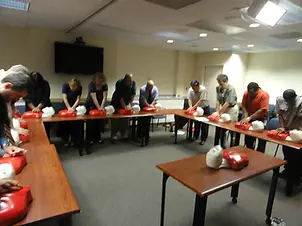
We believe the best value comes from training your staff in groups. We are one of the few companies that offer a 1:1 student-to-manikin ratio, which we believe enhances the learning experience.
Don't Be Mislead
We use Traditional & blended training programs. The AHA, HSI or Red Cross does not sanction or support a total online certification. We know how critical the hands on training is, it what makes our programs standout from others.
Certified Training at Emergency First Trainers LLC
At Emergency First Trainers LLC, we offer comprehensive certified training courses for individuals and businesses. Our courses are designed to provide you with the skills and knowledge needed to respond to a range of emergency situations. Our experienced instructors will guide you through the process of performing the recommended certified training. Whether you are looking to fulfill a job requirement or simply want to be prepared for an emergency, our courses will equip you with the skills to save lives.
How Does Online Blended Learning Work?
Part 1 is a convenient online course that covers the cognitive portion of the course.
Part 2 & 3 are combined. This is the Hands-on Practice / Skills Test with a Start the Heart Instructor.
-
Participants who successfully complete Part 1, including the written exam, receive access to a Printable Certificate, granting them entrance to the Hands-on Practice Skills Test with a Start the Heart Instructor.
-
The Online Blended Learning course includes online access to the student manual and course information for 24 months.

Advance Cardiac Life Support (ALCS)
TO LEARN MORE OR SCHEDULE TRAINING
ACLS COURSE COVERS:
The ACLS Course is a specialized, advanced program designed for healthcare professionals who either direct or participate in the management of cardiopulmonary arrest or other cardiovascular emergencies.
This course takes your Basic Life Support (BLS) foundation to the next level. It emphasizes the importance of continuous, high-quality CPR and focuses on the critical bridge between the patient’s initial collapse and their recovery in the hospital.
WHAT YOU WILL LEARN
Through a mix of simulated clinical scenarios and hands-on skills stations, you will master:
-
Systematic Assessment: How to perform a rapid clinical evaluation of adult patients.
-
Advanced Airway Management: Proper use of adjuncts and equipment.
-
Rhythm Recognition: Identifying cardiac arrest rhythms (VF, pVT, PEA, asystole) and peri-arrest rhythms (bradycardia, tachycardia).
-
Pharmacology: Proper administration and timing of life-saving medications.
-
Electrical Therapy: Mastery of defibrillation, cardioversion, and transcutaneous pacing.
-
Stroke Management: Recognition and early intervention for acute ischemic stroke.
-
High-Performance Teams: Critical communication and leadership during a "Megacode."
WHO SHOULD TAKE THIS COURSE?
This course is intended for emergency, intensive care, or critical care professionals, including:
-
Physicians & Nurses
-
Paramedics & EMTs
-
Respiratory Therapists
-
Pharmacists & Medical Students
Prerequisites: A current BLS Provider Card, proficiency in ECG rhythm identification, and a basic understanding of cardiovascular pharmacology.
CERTIFICATIONS & LOGISTICS
-
Certification: ACLS Provider eCard (valid for 2 years).
-
Course Length: Approx. 10–12 hours (Full Course) or 5–6 hours (Update/Renewal).
-
Materials: All students must have access to the current ACLS Provider Manual.
Pediatric Advanced Life Support (PALS)
TO LEARN MORE OR SCHEDULE TRAINING
PALS: Pediatric Emergency Care
PALS COURSE COVERS:
Gain the confidence and technical skills required to manage pediatric emergencies:
-
The Pediatric Assessment Triangle (PAT): Master the "Evaluate-Identify-Intervene" model for rapid patient assessment.
-
Respiratory Management: Identifying and treating upper/lower airway obstructions, lung tissue disease, and disordered control of breathing.
-
Circulatory Management: Recognizing types of shock (hypovolemic, distributive, cardiogenic, and obstructive) and providing rapid fluid resuscitation.
-
Rhythm Recognition & Therapy: Managing pediatric bradycardia, tachycardia, and cardiac arrest rhythms.
-
Post-Resuscitation Care: Initial stabilization and monitoring after a Return of Spontaneous Circulation (ROSC).
-
High-Performance Teamwork: Practicing effective communication and leadership roles in pediatric resuscitation.
ADDITIONAL COURSE COVERINGS:
-
Child CPR and AED Infant
-
CPR Cardiac, respiratory, and shock case discussions and simulations
-
Key changes in pediatric advanced life support
-
Resuscitation and Emergency Cardiovascular Care
-
Management of respiratory emergencies
-
Rhythm disturbances and electrical therapy
-
Systematic Approach to Pediatric Assessment
-
Infant or Child Transport Scenarios

WHO SHOULD TAKE THIS COURSE?
This course is essential for healthcare providers who respond to emergencies in infants and children, including:
-
Pediatricians & Family Physicians
-
Nurses (ER, ICU, Pediatrics)
-
Paramedics & Advanced EMTs
-
Respiratory Therapists
Prerequisites: A current BLS Provider Card and a solid understanding of pediatric ECG rhythms and basic pharmacology.
CERTIFICATIONS & LOGISTICS
-
Certification: PALS Provider eCard (valid for 2 years).
-
Course Length: Approx. 10–12 hours (Full Course) or 5–6 hours (Update/Renewal).
-
Materials: Students must have the current PALS Provider Manual and complete the AHA Pre-course Self-Assessment.
Basic Life Support (BLS)
TO LEARN MORE OR SCHEDULE TRAINING
BLS COURSE COVERS:
The BLS Provider Course is the foundational certification for healthcare professionals and first responders. It trains participants to promptly recognize several life-threatening emergencies, give high-quality chest compressions, deliver appropriate ventilations, and provide early use of an AED.
This course reflects the latest AHA Guidelines for CPR and Emergency Cardiovascular Care (ECC), focusing on the critical skills required to improve survival rates through the "Chain of Survival."
KEY LEARNING OBJECTIVES
In this hands-on, instructor-led course, you will learn and practice:
-
High-Quality CPR: Correct technique for adults, children, and infants.
-
The AHA Chain of Survival: Understanding the critical steps for both in-hospital and out-of-hospital cardiac arrest.
-
AED Training: Safe and effective use of an Automated External Defibrillator.
-
Effective Ventilations: Using a barrier device and bag-mask device.
-
Team Dynamics: How to perform as an effective team member or leader during multi-rescuer CPR.
-
Choking Relief: Foreign-body airway obstruction maneuvers for adults and infants.
WHO SHOULD TAKE THIS COURSE?
This course is designed for healthcare professionals and other personnel who need to know how to perform CPR and other basic cardiovascular life support skills in a wide variety of in-facility and pre-hospital settings, including:
-
Nurses, Physicians, & Dental Professionals
-
Medical & Nursing Students
-
Physical & Occupational Therapists
-
Paramedics, EMTs, & Firefighters
CERTIFICATIONS & LOGISTICS
-
Certification: AHA BLS Provider eCard (valid for 2 years).
-
Course Duration: Approximately 4.5 hours (Full Course) or 2.5 hours for recertification course
-
Requirements: Completion of hands-on skills practice and a written exam.
Heartsaver
®
CPR/AED
HEARTSAVER COURSE COVERS:
TO LEARN MORE OR SCHEDULE TRAINING
The Heartsaver CPR/AED course is a video-based, instructor-led program that teaches students critical skills needed to respond to and manage a sudden cardiac arrest or choking emergency in the first few minutes until professional help arrives.
This course is specifically designed for anyone with little or no medical training who needs a course completion card for job, regulatory (e.g., OSHA), or other requirements.
KEY LEARNING OBJECTIVES
Using the research-proven "Practice-While-Watching" technique, you will gain hands-on proficiency in:
Adult CPR (optional modules for children and infants) and
-
AED Use: High-quality chest compressions and safe defibrillator operation.
-
Choking Relief: Maneuvers for adults and optional modules for children and infants.
-
Emergency Recognition: Identifying the signs of a heart attack, stroke, or opioid-associated life-threatening emergency.
-
The Chain of Survival: Understanding the concept that improves survival rates.
-
Action Plan: How to assess a scene, phone 9-1-1 effectively, and use an AED as soon as it arrives.
WHO SHOULD TAKE THIS COURSE?
-
This course is ideal for the "lay responder," including:
-
Workplace Personnel: Security, HR, manufacturing, and retail employees.
-
Community Members: Teachers, coaches, daycare workers, and parents.
-
Non-Medical Professionals: Anyone who wants to be prepared for an emergency at home or in the community.
-
(Note: Medical professionals should typically enroll in BLS Provider instead.)
CERTIFICATIONS & LOGISTICS
-
Certification: Heartsaver CPR/AED Course Completion Card (valid for 2 years).
-
Course Length: Approximately 3 to 4.5 hours, depending on optional modules (Child/Infant).
-
Materials: Includes the Heartsaver Student Workbook or eBook.
Heartsaver
®
First Aid
HEARTSAVER COURSE COVERS:
TO LEARN MORE OR SCHEDULE TRAINING
The Heartsaver® First Aid course provides students with the critical skills needed to respond to and manage an emergency in the first few minutes until professional help arrives. This program teaches participants to recognize common first aid emergencies, call for help effectively, and perform lifesaving actions for a variety of illnesses and injuries.
KEY LEARNING OBJECTIVES
-
Using the research-proven "Practice-While-Watching" technique, you will gain proficiency in:
-
First Aid Basics: Duties and responsibilities of first aid rescuers, including scene safety and finding the problem.
-
Medical Emergencies: How to assist with breathing problems, choking, heart attacks, strokes, and using an epinephrine autoinjector for allergic reactions.
-
Injury Emergencies: Proper response to external bleeding, shock, broken bones, and sprains.
-
Environmental Emergencies: Management of bites, stings, and temperature-related emergencies.
-
Preventing Illness: Proper use and removal of personal protective equipment (PPE), handwashing, and universal precautions.
WHO SHOULD TAKE THIS COURSE?
-
This course is specifically designed for individuals with little or no medical training who need first aid certification to meet job, regulatory, or licensing requirements. It is ideal for:
-
Workplace Responders: Human resources, manufacturing, security, retail, and hotel staff.
-
Childcare & Education: Teachers, coaches, daycare workers, and camp staff.
-
Trade Professionals: Electricians, plumbers, and construction workers.
-
Community Members: Anyone who wants to be prepared to act in an emergency at home or in public.
CERTIFICATIONS & LOGISTICS
-
Certification: AHA Heartsaver First Aid Course Completion Card (valid for 2 years).
-
OSHA Compliant: This course meets OSHA and other regulatory requirements for first aid training.
-
Course Length: Approximately 2 to 3 hours for the full classroom session.
-
Materials: Includes the Heartsaver First Aid Student Workbook or eBook.
Heartsaver
®
Bloodborne Pathogen
HEARTSAVER COURSE COVERS:
TO LEARN MORE OR SCHEDULE TRAINING
The Heartsaver Bloodborne Pathogens course is designed to meet OSHA requirements for bloodborne pathogens training when paired with site-specific instruction. This course teaches participants how to protect themselves and others from exposure to blood or blood-containing materials in the workplace.
Using the "PACT" framework—Protect, Act, Clean, Tell—students learn simple, effective steps to manage an exposure incident safely.
KEY LEARNING OBJECTIVES
This course provides the essential knowledge to stay safe in high-risk environments:
-
Pathogen Fundamentals: Understanding what bloodborne pathogens are (such as Hepatitis B, Hepatitis C, and HIV) and how they are spread.
-
Protection (P): How to use personal protective equipment (PPE) like gloves and eye protection to prevent exposure.
-
Action (A): The critical steps to take immediately if an exposure to blood or potentially infectious materials occurs.
-
Cleaning (C): Proper procedures for decontaminating themselves and the work area after a spill.
-
Reporting (T): When and how to tell a supervisor about an incident to ensure proper medical follow-up.
-
Universal Precautions: Treating all blood and body fluids as if they are infectious.
WHO SHOULD TAKE THIS COURSE?
This course is specifically for individuals in the commercial market with a "reasonable chance" of occupational exposure:
-
Childcare Workers & School Personnel
-
Tattoo Artists & Body Piercers
-
Security Guards & Correctional Officers
-
Maintenance Workers & Hotel Housekeepers
-
Health & Fitness Club Staff
CERTIFICATIONS & LOGISTICS
-
Certification: AHA Heartsaver Bloodborne Pathogens Participation Certificate.
-
Compliance: Designed to satisfy OSHA Standard 1910.1030 requirements.
-
Course Length: Approximately 1 hour.
-
Validity: OSHA requires this training be renewed annually
Emergency Medical Responder
EMR COURSE COVERS:
TO LEARN MORE OR SCHEDULE TRAINING
The Emergency Medical Responder (EMR) course provides the knowledge and skills necessary to provide immediate lifesaving interventions while awaiting additional Emergency Medical Services (EMS) resources. EMRs are a vital part of the EMS system, often arriving first on the scene to stabilize patients before an ambulance arrives.
This comprehensive program focuses on the foundational skills of emergency care, emphasizing rapid assessment, lifesaving medical interventions, and critical trauma care.
KEY LEARNING OBJECTIVES
Participants will master the essential skills required for the initial response to medical and trauma emergencies:
-
Preparatory Skills: Understanding the EMS system, safety/wellness, and legal/ethical issues.
-
Patient Assessment: Performing rapid primary and secondary assessments of medical and trauma patients.
-
Airway Management: Mastery of basic airway adjuncts, oxygen administration, and suctioning.
-
Medical Emergencies: Managing cardiac, respiratory, diabetic, and allergic reactions.
-
Trauma Care: Controlling hemorrhage, managing shock, and stabilizing fractures or spinal injuries.
-
Special Populations: Basics of obstetric care, neonatal resuscitation, and geriatric emergencies.
-
EMS Operations: Gaining proficiency in incident management and multiple-casualty triage.
WHO SHOULD TAKE THIS COURSE?
This course is designed for individuals who are likely to be the first to arrive at the scene of an emergency, including:
-
Public Safety Professionals: Police officers and firefighters.
-
Workplace Responders: Industrial safety teams and mine rescue workers.
-
Community First Responders: Ski patrol, athletic trainers, and park rangers.
-
Future EMS Professionals: Individuals seeking a foundational step before EMT-Basic training.
CERTIFICATIONS & LOGISTICS
-
Certification: National Registry or State EMR Certification (varies by region).
-
Course Length: Typically 40 to 60 hours of classroom and skills training.
-
Prerequisites: Students must be at least 16 years of age (varies by state) and hold a current Healthcare Provider CPR certification.